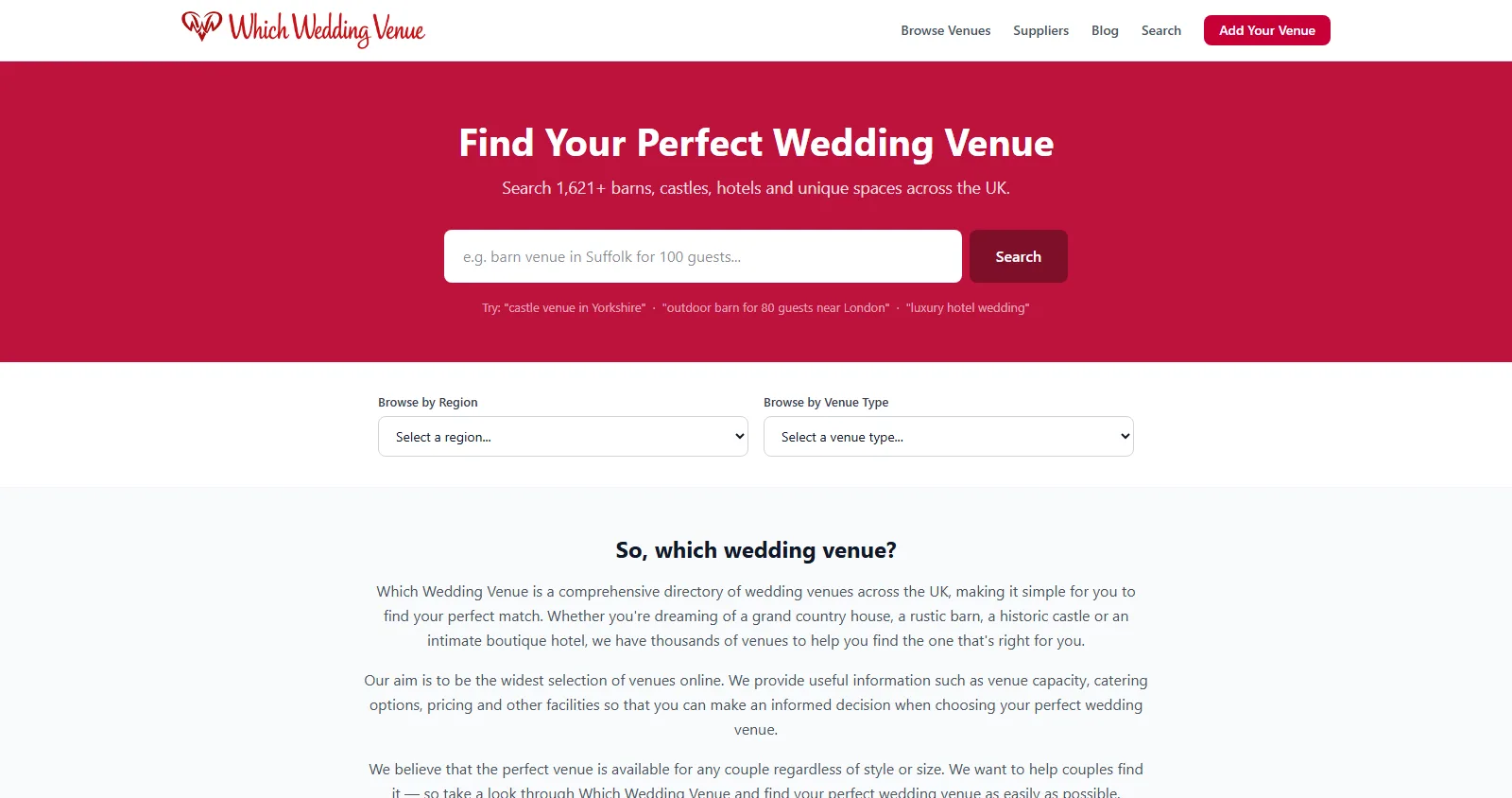
Which Wedding Venue is a UK wedding venue directory carrying more than 1,600 listings. It was rebuilt from the ground up as bespoke software, with AI doing the work a content team would normally do. It is the fullest example we can show of what we mean by bespoke software with AI inside it rather than bolted on.
The problem with the old platform
The directory had outgrown WordPress and was ready for a platform built for its scale.
The directory had grown to over 1,600 listings on WordPress and was ready for more than the platform could give it. The rebuild set out to give every listing a full description, and to capture capacity, price and amenities as structured information, which is what the filtering couples actually want depends on.
The rebuild also set out to automate the routine work of adding a venue, updating details and contacting an owner, and to give venues a clear route from a free listing to a paid one.
The requirement was clear. Rebuild it as a platform with AI embedded in the listing lifecycle, handling the routine work so that people spend their time on the venues, with a clear route from a free listing to a paid subscription.
Moving a decade of search rankings without losing any of it
Search equity built over ten years had to be preserved during the rebuild.
The first job on a rebuild this size is not losing what already works. All 1,600 or so listings moved across through a re-runnable import pipeline that merged duplicates, normalised everything into a proper relational schema, and mapped every legacy URL to a redirect so existing rankings carried over intact.
Re-runnable matters more than it sounds. Being able to run the import repeatedly is what turns a migration from a single alarming event into something you can rehearse until it is routine.
AI that writes the content, and knows when it is unsure
Hundreds of listings needed substantial descriptions, and manual writing was no longer viable.
Hundreds of venues had little or no copy. Descriptions are now generated by the Claude API from the structured details each venue already publishes about itself. Each one is written individually rather than assembled from a template, assigned to categories, and given a confidence score.
That last part is the design decision that makes the whole thing workable. High confidence content publishes automatically. Anything the model is uncertain about goes into a human review queue instead. The alternative, trusting everything or checking everything, is the choice most people assume they face, and it is a false one. The confidence threshold is what makes the pipeline workable at scale.
Search that understands the question without letting the model near the database
Couples search in natural language, not in database terms, so search needed to bridge that gap safely.
Nobody looking for a wedding venue searches the way a database wants to be asked. They type something like "barn near York for 120 guests". So the query goes to a language model whose only job is to turn that sentence into structured criteria: region, style, capacity, price band, distance.
What it does not do is write the query. The model returns a set of fields, each one checked against a list of things it is permitted to return, and anything unrecognised is discarded. The search is then built in the ordinary way with bound parameters, exactly as it would be if someone had ticked boxes on a form.
That division is deliberate, and it is the part we would defend hardest. Because the model cannot reach the database and cannot emit a query, an attempt to manipulate it through the search box has nowhere to go. It is not filtered out, it is structurally incapable of becoming a database instruction. A great deal of what is currently being built with AI puts the model in the query path, and that is a far harder thing to make safe. This structural separation is what keeps the search safe, predictable and resistant to manipulation.
The result is a directory where couples can browse more than 1,600 UK wedding venues by capacity, price per head and setting, from barn wedding venues to castle venues, on data that did not exist in usable form before.
A directory that keeps itself up to date
New venues needed to be discovered, enriched and published automatically.
Scheduled sweeps of the Google Places API discover new venues county by county and check them against what is already listed, so nothing arrives twice. A genuinely new venue then goes through an enrichment pipeline of its own. Its published details are gathered, a description written, categories assigned, capacity and price band estimated.
A venue can go from discovered to published automatically, with anything uncertain held for a person to check. That keeps the directory current for couples and accurate for venues.
Billing that follows the listing, not the login
Subscriptions needed to attach to listings rather than user accounts.
Most subscription software attaches a plan to a user account. That does not work for a directory, where what is being paid for is a venue's placement rather than a person's access, and where a venue exists on the site long before anyone claims it.
So the subscription drives the listing itself. Every venue moves through three states: published automatically, claimed by its owner, then upgraded to featured. A successful payment is what moves a claimed venue to featured, and the expiry of that placement is recorded against the venue rather than looked up from the payment provider when a page loads. Featured placement and badges are then a single column check, so a page listing fifty venues makes no external calls at all.
The part worth copying is what happens when a payment fails. The subscription retries, and if it keeps failing the venue drops back to claimed. It does not come down. A lapsed subscriber is still a live listing, still bringing visitors in, and still someone worth talking to again in three months. Cutting them off would have cost the directory its inventory and the owner a relationship, and saved nothing.
Outreach that is automatic, and within the rules
Venue owners needed clear, compliant communication without manual sending.
Automated, personalised email sequences tell venue owners their venue is listed, how many couples have viewed it, and what an upgrade delivers. The sequences are built to UK PECR rules, with permanent suppression handled properly rather than as an afterthought, which is the part most automated outreach gets wrong and the part that matters if you intend to still be sending in five years.
Human time spent where it matters
The routine work is automated, so human time goes on the cases that need judgement.
Everything surfaces on one screen. A Filament admin panel showing subscription and funnel figures, the AI review queue, and the health of the background jobs that keep the whole thing moving.
The entire operational workload is approving or rejecting the things the automation was not sure about. That is the point of the exercise. Not that AI writes copy, because plenty of things write copy, but that routine work is handled automatically, and people give their attention to the cases that need it.
Where it got to
- Over 1,600 listings migrated with full data integrity and no loss of search visibility
- Structured capacity, pricing and amenity data supporting richer search, across 48 venue types and every UK county
- A substantial description on every listing, generated and reviewed
- A route from free listing to claimed to premium subscription, running on automated outreach and custom Stripe billing built for the rebuild
- Day to day operation reduced to a review queue rather than continuous administration
Common questions
How does the directory keep its search rankings after a rebuild?
By mapping every legacy URL to a redirect and migrating all listings through a re-runnable import pipeline. This preserves search equity built over a decade and avoids the ranking losses that normally follow a platform change.
Can AI really write venue descriptions accurately?
Yes, when it is given structured data and a confidence threshold. High-confidence descriptions publish automatically, and anything uncertain goes into a human review queue. This avoids both blind trust and checking everything manually.
Does the AI ever touch the database or write queries?
No. The model only interprets natural language into structured criteria. It cannot reach the database or emit a query, which is what makes the search safe. The actual search is built with bound parameters exactly as if someone had ticked boxes on a form.
How does the directory avoid duplicate venues?
Scheduled sweeps of the Google Places API check new discoveries against what is already listed. Only genuinely new venues enter the enrichment pipeline, so duplicates never appear.
Can a venue be published automatically?
Yes. New venues go through an automated enrichment pipeline: details gathered, description written, categories assigned, capacity and price band estimated. Human review only happens when the model is unsure.
How does billing work when listings exist before owners claim them?
Subscriptions attach to the listing, not the user. A venue moves from published to claimed to featured, and featured placement is a single column check. Failed payments drop a venue back to claimed rather than removing it, preserving inventory and relationships.
Is automated outreach compliant with UK PECR rules?
Yes. Permanent suppression is handled correctly, and sequences only contact owners within the rules. This is the part most automated outreach gets wrong, and the part that matters if you intend to still be sending in five years.
How much time does the directory take to run day-to-day?
Very little. The operational workload is approving or rejecting the small number of items the automation was unsure about, which leaves time for the venues themselves.
The same thinking, applied to your business
Every technique here has an equivalent in a business that sells something. An AI pipeline with a confidence threshold rather than blind trust. A data set that grows on its own. Billing that behaves correctly at the edges. One dashboard instead of six.
If you have described something to a developer and been told it is not possible, or you are running a business on manual work that ought to be automatic, that is the kind of project we take on. Tell us what you have in mind.
Start with the free AI readiness audit; it is the quickest way to see what is worth doing first.