In that time we have worked with several hundred businesses, from one-person makers to suppliers turning over millions. The thing clients tell us most often is that we are the first developer who explained what was actually happening.
Behind eCentury is David Walker, who founded the company and still does the work. The person who quotes your project is the person who writes the code. There is no account manager in between, and nothing is passed to whoever happens to be free that week.
Before eCentury
David started selling DVDs online in 2001 and built the shop that sold them. The first ecommerce system he wrote was one his own livelihood depended on. If the checkout was wrong, he lost the money.
At its peak the business handled around two thousand orders a day and sold somewhere in the region of ten million units over eight years. It was one of the earliest business sellers on eBay in the UK, at a time when most of the platform was still people clearing out lofts. eBay noticed. They asked him to design a banner and put it on their own front page, linking to his shop at no cost. That is not an offer anybody gets now.
The catalogue listed over a hundred thousand titles, supported by integrations with the studios that ran on EDI, long before APIs were common. Each studio had its own format and timing, and the whole system had to run reliably without anyone watching, because any silent failure meant a customer order that was not being processed.
The physical side ran through a third-party warehouse. Their system knew what had arrived, what had been picked and what had gone out of the door; the shop knew what had been sold. At two thousand orders a day the gap between the two was never small for long. When tracking numbers failed to sync, nobody knew where their order was. When barcodes were wrong, the wrong film shipped. None of these problems were dramatic, but all were expensive.
The same catalogue ran across eBay, Amazon and the shop's own site. Three sets of rules, three fee structures, three ways to be delisted on a Tuesday morning, and one stock position underneath that had to be correct everywhere at once.
David built all of it because nothing existed to buy that did the job. The tools then were nothing like today's, and a great deal of it ran on spreadsheets and macros held together by someone learning as he went. When he tells a client something will cause trouble later, it is usually because he has already built the version that did.
What eight years of selling taught him
It was eight years spent on the other side of the relationship eCentury now sells into. The problems clients describe are problems he has had, not problems he has read about.
- Stock is the whole business. Nothing focuses the mind on accurate stock data like promising two thousand people a day that you have something you have not bought yet.
- Integrations are where the money is. They were the difference between a hundred thousand listings and a few hundred. Most shops have one integration that would pay for itself in months.
- Small friction is expensive at volume. A checkout losing a modest percentage is a rounding error on ten orders and a serious sum on two thousand.
- Returns, fraud, couriers and cashflow are the actual job. The website is the easy part, and the part most developers think is the whole thing.
- Platforms change the rules without asking. Fees, policies, search placement, what you are allowed to sell. You find out afterwards.
- Clients should own their shop outright. Open-source software, hosting in their name, no commission on sales, nothing held hostage. He built and adapted open-source systems for his own business and learned how important it is to control the platform you depend on.
Those eight years are why eCentury builds for the business, not just the website.
Then eCentury
David started eCentury in 2007 while the DVD business was still running. Other small sellers kept asking how it worked, and answering them turned out to be the more interesting job. The DVD market was slowing as digital arrived, and in 2009 he stopped selling and kept the part where he helps other people build theirs.
A developer builds what you ask for. Someone who has had to live with what they built asks whether it is the right thing to build, notices when the real problem is the stock feed rather than the homepage, and says so when the cheaper answer will do. The site is one part of a business that has to work, and the site is rarely the part that is broken.
Helping a business succeed and building it a website are not the same job. It is also why we will talk you out of spending money you do not need to spend.
Experience matters in this trade
Many web agencies disappear within a few years, leaving their clients with a site nobody understands. eCentury has been building shops since 2007, and that longevity is a practical benefit for the people we work with.
We have seen platforms come and go. We built on static HTML, then Joomla, then WordPress and Magento, and now PrestaShop, WooCommerce and Laravel. That history is why we are sceptical of whatever is fashionable this year, and why we will tell you when the boring option is the right one.
We have made the mistakes already. Nearly every hard-won piece of advice on this site, about migrations, checkout, hosting, and what breaks at three in the morning, came from doing it wrong once and remembering.
Several of the businesses in our portfolio have been with us for over a decade, through two or three rebuilds. Each rebuild was easier than the last because we already understood how they sell.
How we work
These are the rules we have run on since 2007, and they are the reason people stay.
- A free, detailed written quote before anything starts.
- The design is agreed before a line of code is written.
- You own everything: open-source software, hosting in your name, code that goes with you.
- We will talk you out of spending more than you need to.
- We explain things. You should finish a conversation understanding your own website better than when you started.
- We work with small businesses, and always have. No minimum project size, no account manager, no sales team, no offshore subcontractor.
- Every project is quoted individually, because a figure given before understanding the work is a guess dressed up as a price.
The work
The clearest thing we can tell you about eCentury is what we have built: a shelving supplier's trade store, a lighting retailer selling to installers, a veterinary reference platform, a craft blanks wholesaler, a tree and hedging nursery, an equality consultancy's assessment software, and, some years ago, a business that went on to be featured on Dragons' Den.
A few recent projects.

RedPrice
A general price comparison site launched from scratch
A broad UK price comparison site for tech and home appliances, launched from a parked domain on a bespoke Laravel platform.
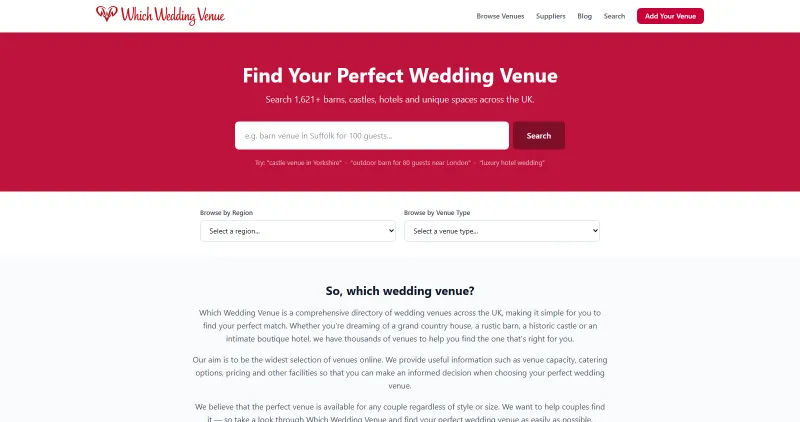
Which Wedding Venue
A UK wedding venue directory rebuilt as bespoke AI software
Rebuilt from WordPress into bespoke software with AI embedded throughout the listing lifecycle.
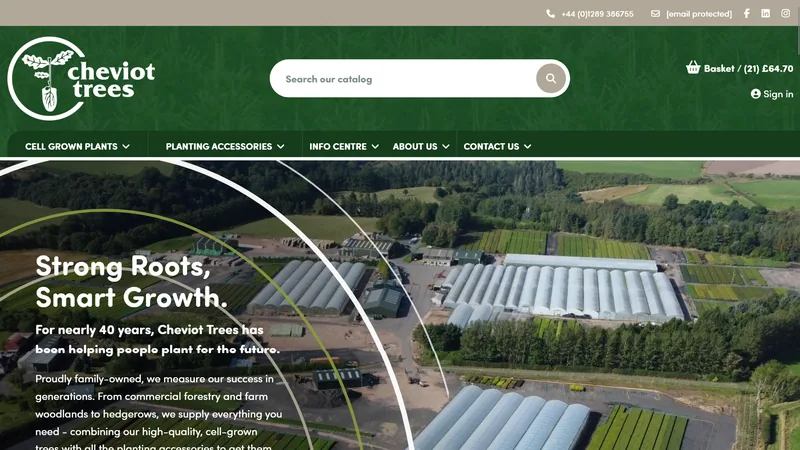
Cheviot Trees
Long-running PrestaShop development for a busy UK tree nursery
Cheviot Trees grow and supply cell-grown trees and hedging across the UK. We have looked after their PrestaShop installation for several years, covering development, payments, performance, security and search.
See the full portfolio: most entries explain the actual problem and what we did about it, rather than just showing a screenshot.
Where the business is going
Ecommerce development is still what we do most, and PrestaShop and WooCommerce still pay the bills. But an increasing share of our work is now bespoke software: systems built from scratch, on Laravel, for businesses whose requirements no off-the-shelf product can meet. More and more of those have AI doing real work inside them rather than bolted on for the sake of it.
We built EqualityIQ, an AI-assisted platform for producing equality impact assessments, and we are building tools that apply the same thinking to running an online shop. If you have described something to a developer and been told it is not possible, that is the kind of work we now take on.
The company
eCentury Ltd is a UK limited company, number 06352478, registered and working from The Kiln, 2 Copenhagen Street, Worcester WR1 2HB. We work with clients across the UK and have done since the beginning. Worcester is where we are, not a limit on who we work with.
Questions people ask before getting in touch
Have you ever actually run an online shop yourself?
Yes. David, who founded eCentury and still does the work, ran one for eight years, starting before the company existed, and built it as well as ran it. He sold DVDs online from 2001, handling around two thousand orders a day at the peak and shipping roughly ten million units in total over eight years. That is why the advice you get here tends to be about stock accuracy and checkout friction rather than design trends.
How big is eCentury?
Deliberately small. You deal directly with the developer doing your work, which is why the explanations are straight and the decisions are quick. For larger projects we bring in people we have worked with for years, but the responsibility and the relationship stay with us.
We are a small business. Are we too small for you?
No. Most of our clients are owner-run, and a good share of our work is a single specific job rather than a whole project. If what you need is an afternoon's work, we would rather do that and do it well than talk you into something larger.
Can you take over a website someone else built?
Yes, and we do it often. It usually starts with an honest assessment of what you have got: sometimes the right answer is to fix it, sometimes it is to rebuild, and we will tell you which we think it is and why.
What happens if something breaks?
You contact us and we deal with it. We do not publish guaranteed response times, because we would rather not make a promise we cannot always keep. What we can say is that clients who have been with us for a decade have not gone anywhere.
We have thousands of products. Is that a problem?
No, and it is usually the interesting part. David's own shop listed over a hundred thousand titles, ordered from the supplier as customers bought them and fulfilled through a warehouse whose system had to agree with his. Large catalogues are less about the website than about the data behind it and what it is connected to, which is where we would start.
Why do you insist that clients own their own software and hosting?
Because David once built a business on software he could not change. It was not open source, so when it did not do what the business needed, he could not open the code and fix it. Owning your shop outright on open-source software, on hosting in your name, means you are never in that position. It is the single piece of advice we give most consistently.
You have started doing AI work. Is that a distraction from the ecommerce side?
The AI work is newer than the ecommerce work. Ecommerce development and support is still most of what we do. What made the AI work worth taking on is that it is the same job we have always done, which is getting rid of work a business should not be doing by hand. In 2001 that meant spreadsheets and macros. By the middle of that decade it meant supplier integrations. It is a better tool for an old problem rather than a different business, and if AI is not the right answer for you we will say so.
Talk to us
If you have a project in mind, or a website that is not doing what it should, tell us about it. You will get a straight answer and a free written quote, with no obligation and nobody chasing you afterwards. Get in touch.